
Information Stratigraphy: A Five-Level Model of Sources Behind AI Visibility
##plugins.themes.academic_pro.article.sidebar##
Downloads
##plugins.themes.academic_pro.article.main##
Abstract
The spread of generative artificial intelligence is changing how information about organisations, companies and individuals is formed and circulated. Instead of a list of documents to examine for themselves, users increasingly receive a synthesised answer that draws on many sources at once. Research on AI Visibility has mostly examined the observable output of this exchange: mentions, citations, recommendations and the properties of answers. Yet the public information environment that surrounds a given entity before anyone queries an AI system can itself be treated as an object of scholarly study.
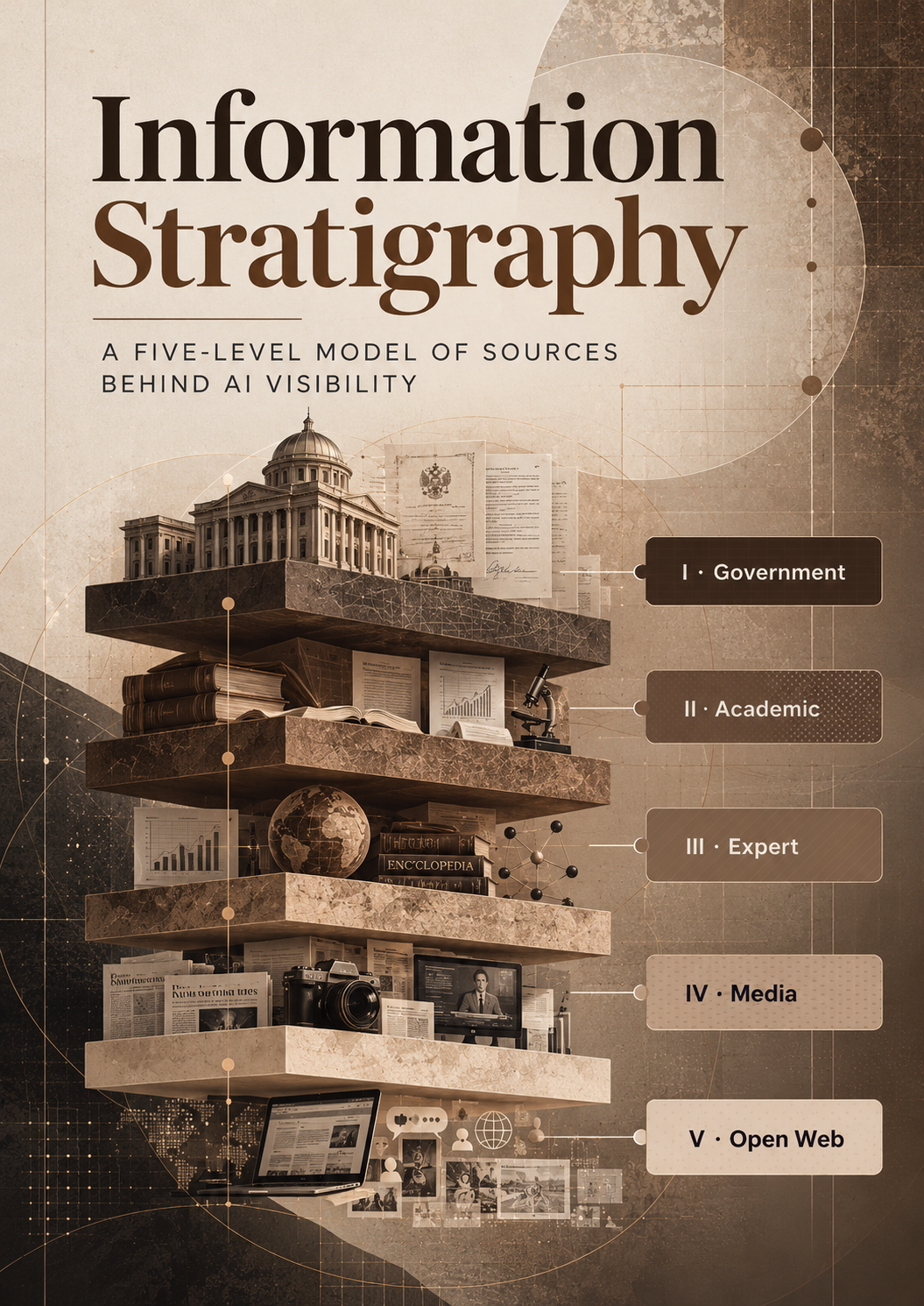
This article proposes the QuorumLab Information Stratigraphy Model (QISM), a five-level heuristic model of an entity's public information environment. It distinguishes government, academic, expert, media and open-web levels, and its main classificatory principle is the institutional procedure to which a document is subject. The model separates the document, the claim it contains and the producer of the information. It also takes account of provenance, affiliation, currency and the technical conditions under which AI systems gain access to sources.
The theoretical basis draws on research into gatekeeping, cognitive authority, the social organisation of information flows and the sources of generative search. We also review studies showing that training data, document characteristics and source identity matter for generative answers.
QISM has both scholarly and practical value. It allows a researcher to build a structured information map of an organisation or person, trace where information comes from, identify discrepancies and formulate new research hypotheses. The model sets out a sequential research programme that moves from describing the public environment to comparing it with AI Visibility, examining potential influencing factors and testing them empirically.
The paper is conceptual and methodological. It presents a heuristic model intended as a foundation for subsequent research.
##plugins.themes.academic_pro.article.details##

This work is licensed under a Creative Commons Attribution 4.0 International License.