
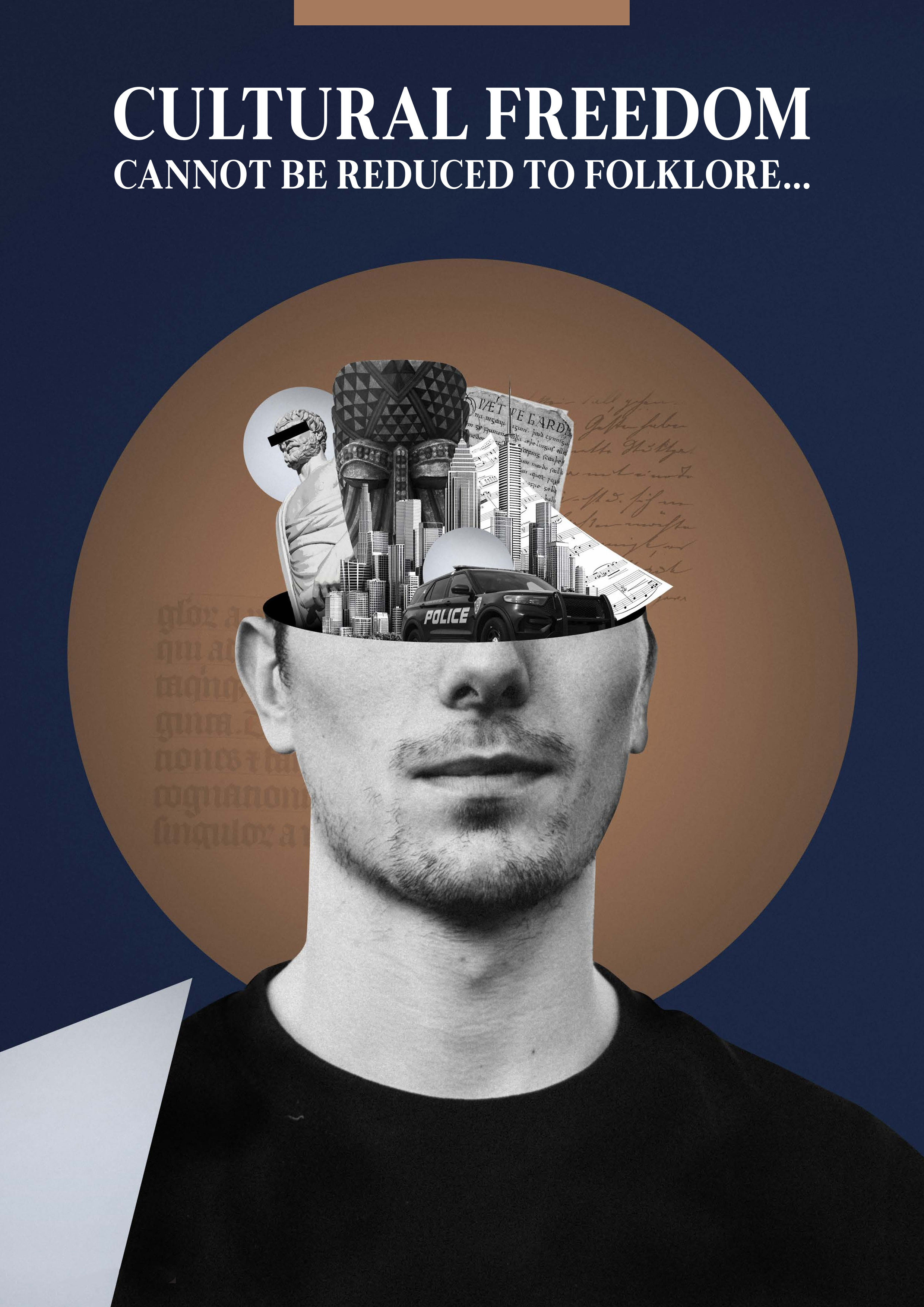
CULTURAL FREEDOM CANNOT BE REDUCED TO FOLKLORE...
##plugins.themes.academic_pro.article.sidebar##
Downloads
##plugins.themes.academic_pro.article.main##
Abstract
When “culture,” meaning all those ways of being communicated through internal (thoughts) and external actions (languages and various “codes” personified in attitudes) within given “groups” (ethnic groups, nations “grouping” them together in a more or less conflictual manner) is not re- duced to folklore (such as decorative art) or social engineering (management of the “flow” of signs within it) this implies that each of these actions (internal and external) is necessarily political in the broad sense: not only personified by an explicit sovereign power (Polis or State), but also implicitly bound together by a shared internal and external reality (Politeia or “nation”).
However, while this distinction (which is not a separation) between Polis (sovereignty of choices within a nation-state) and Politeia (cul- ture of sense of belonging in the strong sense of civilization) and their confrontation (there are “nations” without “state” without “Polis”) seems universal, it is also partly invisible. It is, in a way, “the code of codes,” translated, for example, al- beit partially, in international relations through diplomacy or the “trade” of intelligent and “soft” power acting through civilizational influence rather than through the mere demonstration of force.
And this code of codes operates in part in the interstices, in the unsaid, the implicit, in order to live and act “on the edge,” that is, some- times in a disruptive transgression within the social stratification, revealing certain flaws;
which means that while knowledge of this code of codes does indeed make it possible to preserve and even extend acquired positions, its recogni- tion can also put us in danger.
For it can shed light on its gray areas; this is, for example, what the war in Ukraine reveals today as the clash between Polis and Politeia, personified by certain ways of preserving oneself that are quite close to the negative refinement embodied by the selfishness and sectarianism of certain individuals, personified in particular by the arrest and detention for more than a year and a half of an eminent researcher in the field of depth psychology, more precisely the study of the interstices between explicit and implicit codes: Oleg Maltsev. How does this arrest serve as a mirror revealing the invisible side of these codes that animate the tacit and implicit life of this link between Polis and Politeia?
##plugins.themes.academic_pro.article.details##

This work is licensed under a Creative Commons Attribution 4.0 International License.