
STATE OF EXCEPTION AS A LEGAL DISPOSITIVE OF MODERN BIOPOLITICS
##plugins.themes.academic_pro.article.sidebar##
Downloads
##plugins.themes.academic_pro.article.main##
Abstract
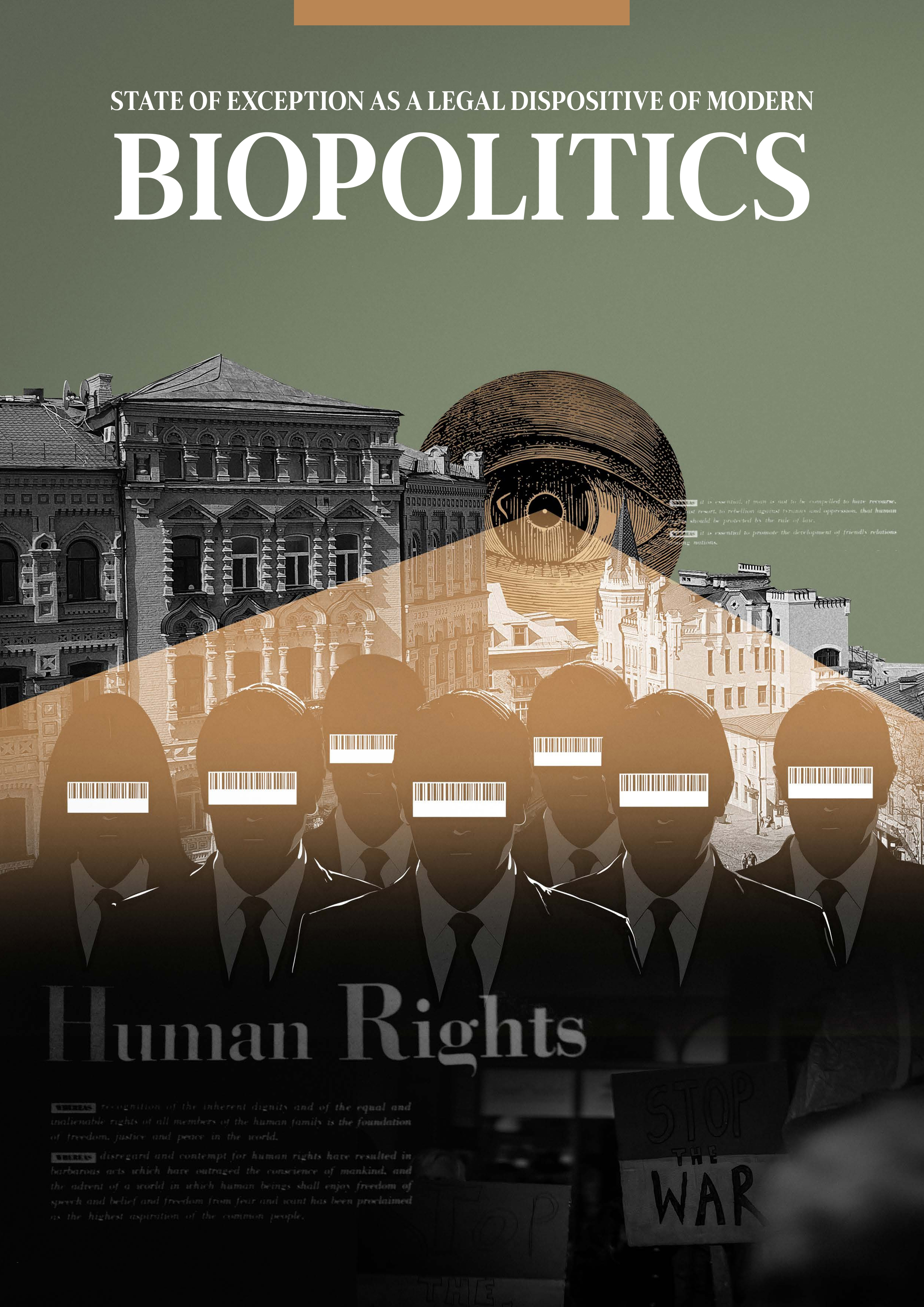
In recent decades, the problem of biopolitics has occupied one of the central positions in contemporary social and political philosophy. Beginning with the works of M. Foucault, bio- politics has been understood as a specific form of power oriented not so much toward territory or the legal status of the subject as toward the governance of the life of the population in all its biological, social, and cultural dimensions. Within this approach, political power increas- ingly manifests itself as power over life, cor- poreality, health, reproduction, and mortality. A phenomenon of particular significance within the structure of biopolitical governance is the state of emergency. Whereas in the classical legal tradition the state of emergency was understood as a temporary and exceptional measure aimed at restoring a disrupted order, under conditions of late modernity and contemporary digital so- ciety it gradually loses its temporary character. The state of emergency increasingly functions as a stable paradigm of governance, within which the suspension of legal norms becomes not an exception but a norm of the political practice of modern sovereign power. The theoretical com- prehension of this process is associated with the works of G. Agamben, C. Schmitt, R. Esposito, S. Žižek, A. Mbembe, R. Braidotti, W. Watkin, and other scholars, who point to the systemic nature of the interrelation between sovereign power, biopolitics, and the state of emergency. Their works emphasize that contemporary poli- tics increasingly operates within a space of legal indeterminacy, where the boundaries between law and its suspension, between norm and ex- ception, become blurred. An additional factor
in the radicalization of biopolitical mechanisms is the rapid digitalization of social processes. The development of surveillance technologies, big data analytics, algorithmic governance, and artificial intelligence significantly expands the capacities of power to control and regulate the population. Digital society produces new forms of the biopolitical body, in which physical and social corporeality are supplemented by virtual and informational dimensions subject to contin- uous monitoring and controlling interventions. In this context, the analysis of the relationship between biopolitics and thanatopolitics acquires particular relevance. The governance of life is in- creasingly intertwined with the institutionalized possibility of exclusion, social annihilation, or physical elimination of individual subjects and entire population groups. The concept of necro- politics proposed by A. Mbembe makes it possi- ble to capture the extreme forms of biopolitical rationality in which power is exercised through the production of «death-worlds» and the trans- formation of populations into a governable bio- material.
##plugins.themes.academic_pro.article.details##

This work is licensed under a Creative Commons Attribution 4.0 International License.